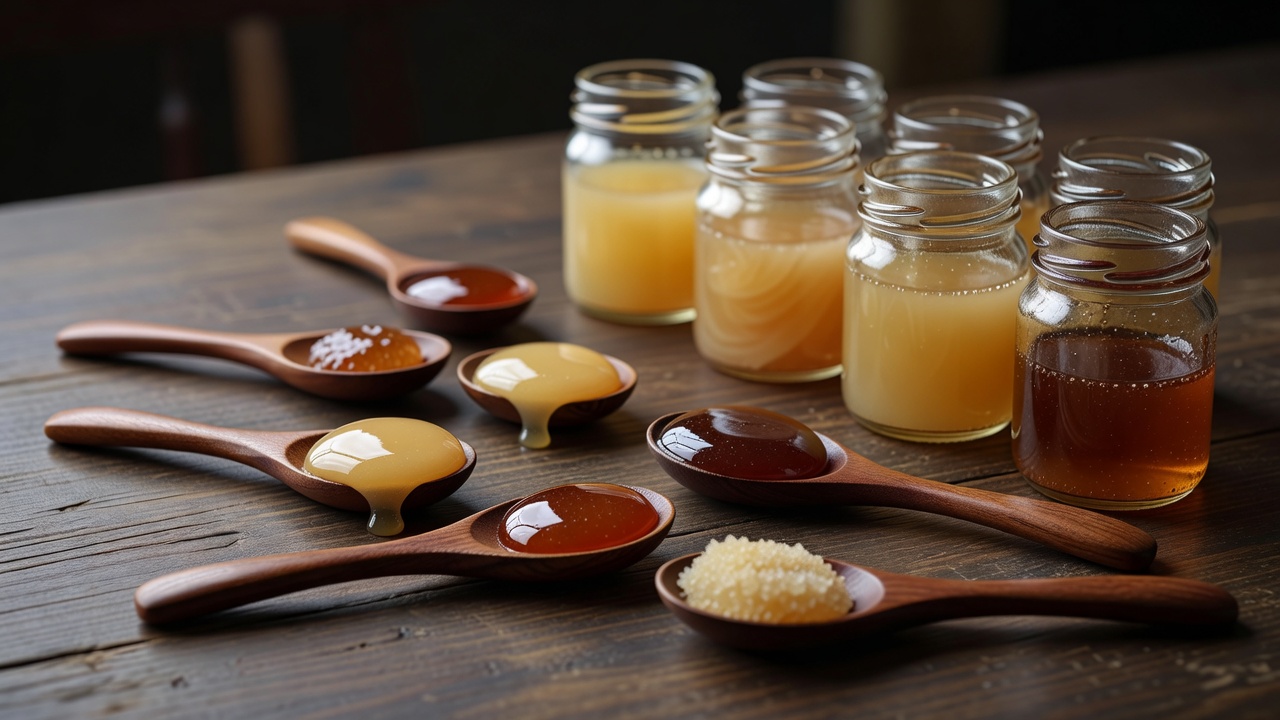
A useful honey tasting does not require elaborate glassware or a vocabulary borrowed from a label. It requires a little separation between observation and expectation. An estate name, a high price or a dramatic landscape photograph can influence what we think we perceive. Begin with a plain sample code if possible, then return to the origin information after making your own notes.
The aim is description rather than competitive scoring. One person may enjoy a quiet floral honey while another prefers a woody, persistent example. Neither preference establishes authenticity, environmental performance or a universal quality ranking. Tasting becomes more informative when enjoyment and evidence are allowed to remain different things.
Prepare a calm comparison
Choose a small number of samples so that sweetness does not overwhelm attention. Use clean, odour-free vessels and a separate clean utensil for each honey. Keep serving conditions similar, and avoid comparing one sample straight from a cold cupboard with another that has been warmed. If a honey is crystallised, note that state rather than treating it as an inconvenience to remove.
Strong perfume, cooking smells and heavily flavoured drinks can interfere with observation. Plain water provides a simple pause between samples. If you offer bread or another carrier, taste the honey alone first and disclose relevant ingredients. Honey must not be given to babies under 12 months; it is also not a treatment for illness.
Move from aroma to finish
- Look without concluding. Record colour, clarity and visible crystals. Appearance is useful description, not an authenticity verdict.
- Smell gently. Notice the first aroma and return after a short pause. Avoid forcing a specific flower name.
- Take a small taste. Attend to sweetness, acidity and any bitterness separately from aroma associations.
- Notice texture. Describe flow, grain size, smoothness or a gel-like impression where present.
- Follow the finish. Record what remains after swallowing and whether the impression changes.
Use a vocabulary that stays open
Start with broad families such as floral, fruity, vegetal, woody, malty, waxy or caramel-like. Add a more specific comparison only when it helps you remember the sample. “Dried fruit, moderate intensity, lingering woody finish” is a more useful note than “excellent”. It also leaves room for someone else to perceive the same sample differently.
These descriptors do not identify ingredients added to the honey. A caramel-like impression does not, by itself, prove heating, and a smoky association does not establish its cause. If a sample appears fermented or otherwise concerning, sensory observation can prompt a question, but it cannot replace a suitable food-safety assessment.
Compare texture without confusing it with purity
A fine-set honey may feel smooth and spreadable, while a naturally crystallised sample may contain larger grains. A liquid honey can seem more flowing or coating. Those differences affect the experience of tasting and can alter how quickly aromas are perceived. Record texture alongside flavour rather than allowing it to become an unspoken preference.
If you want to compare floral sources, try to reduce unnecessary differences in age and storage where practical. Perfect control is rarely possible at a kitchen table, so acknowledge what is unknown. A tasting notebook is useful precisely because it preserves those conditions instead of presenting every impression as an objective property of the region.
Plan an estate visit around learning
Ask the host what the visit actually includes: a live apiary, extraction demonstration, talk or guided tasting. Working schedules depend on weather and harvest conditions, so a promised activity may need to change. Confirm accessibility, protective equipment, photography rules and whether there is a non-hive alternative. Book directly with the operator; this website does not arrange visits or represent estates.
Useful questions connect the experience to a specific batch. Which sample came from the landscape discussed? Was it blended? How was it stored? If the host offers food pairings, return to a plain sample afterwards to separate the effect of the pairing from the honey itself. An enjoyable match can be memorable without revealing origin.
Write notes you can revisit
Record the sample code, lot if available, tasting date, texture, aroma families and finish. Keep the producer’s description in a separate column. Later, compare where your notes agree and where they differ. Differences may reflect language, serving conditions or personal perception; they are not automatically evidence that anyone is wrong.
Formal sensory work uses more controlled methods than a casual visit. ISO 13299 provides a general framework for sensory profiling, but a home tasting should not be presented as an accredited panel result. Its value is practical: it helps you ask clearer questions and choose honey for reasons you can describe.
Prepare tasting correspondence
Reading and source notes
- ISO 13299:2016 — general guidance for establishing a sensory profile.
- International Honey Commission — technical context for honey characterisation.
- NHS: foods to avoid giving babies and young children — guidance on honey and infants.