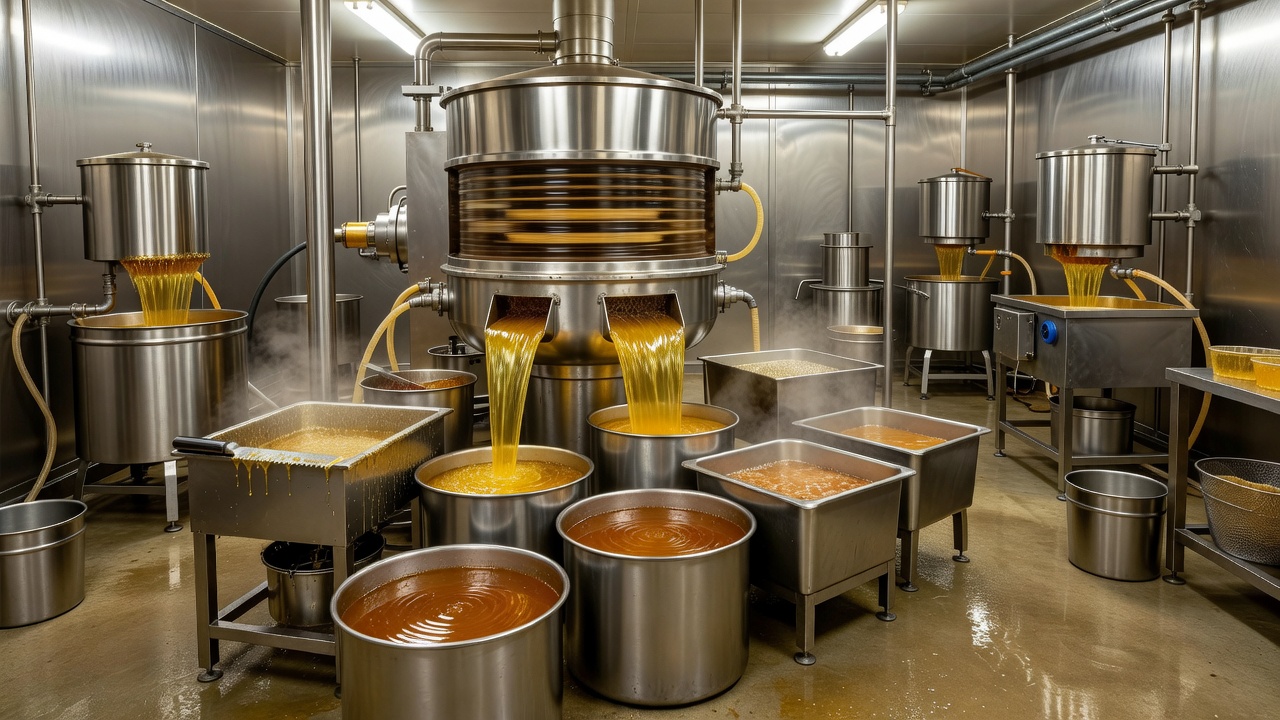
A honey room is most informative when the process can be explained in sequence. A gleaming extractor makes a striking photograph, but visitors should also ask how incoming supers are identified, how equipment is prepared and how batches remain separate. These less theatrical details connect the landscape account to the jar. The purpose is not to turn a visit into an inspection; it is to understand what a producer means by careful handling.
Different honeys and production scales call for different equipment. Some combs are centrifugally extracted, while others may be pressed. Heather honey can require particular handling because of its physical behaviour. The method should fit the product rather than conform to a single romantic image of traditional production.
Follow the extraction sequence
- Identify the harvest. Record the source, collection period and batch relationship before the honey enters shared equipment.
- Assess readiness. Examine the crop and measure moisture appropriately; capped comb alone is not a complete measurement.
- Open the cells. Uncapping removes wax coverings so honey can be released. The exact tools vary with the operation.
- Extract or press. Collect the honey using a method suitable for the comb and honey type, while managing hygiene and foreign material.
- Strain and settle. Separate unwanted wax pieces and allow entrained air or remaining particles to rise where the process calls for it.
- Pack and retain identity. Link the finished containers to batch records, storage conditions and any testing undertaken.
Understand why moisture matters
Honey takes up moisture from its surroundings, so room conditions, container closures and storage practices matter. Higher moisture can increase the risk of fermentation, although stability also depends on other factors. A refractometer is commonly used to estimate moisture, but the instrument needs suitable calibration, a representative sample and correct interpretation.
Regulatory composition requirements include moisture provisions with exceptions for particular honey categories. It is misleading to quote one figure as a universal buying rule without identifying the category and jurisdiction. For a visitor, a better question is how the producer decides a batch is suitable for packing and what happens if a result falls outside its specification.
Ask about warming in practical terms
Warming can make honey easier to transfer or help dissolve crystals. The consequences depend on temperature, duration, the honey itself and its previous storage history. A claim that honey was “never heated” does not, by itself, establish its complete quality profile. Conversely, the mere use of controlled warmth does not explain whether meaningful damage occurred.
Ask what temperatures were used, for how long, and whether the operation keeps records. Hydroxymethylfurfural, usually shortened to HMF, and enzyme activity can help assess aspects of heat exposure and ageing, but neither is a simple recorder of every processing event. The provenance guide explains why measurements need context.
Straining is not the same as every form of filtration
Removing larger wax fragments is a different operation from processing that significantly removes pollen. Everyday descriptions such as “filtered” can blur that distinction. Ask what material the producer intends to remove and which equipment is used. Some legal categories and labelling requirements turn on these details, so the precise process matters more than the reassuring sound of a general term.
Likewise, “raw” should prompt a request for a producer’s working definition. It is not a globally harmonised promise covering every temperature, filter size and storage condition. Specific statements are more useful than assuming all sellers use the word in the same way.
Read crystallisation as a physical change
Many honeys crystallise during storage. Their tendency to do so depends on sugar composition, temperature and available crystal nuclei, among other factors. Fine-set honey is often made by managing crystallisation to create a consistent texture. A liquid jar and a fine-set jar can therefore represent different presentations rather than different authenticity grades.
Coarse crystals may feel sandy on the tongue, while fine crystals can feel smooth. Those are sensory observations, not laboratory conclusions. Store honey closed, away from excess heat and moisture, and follow the producer’s instructions. A clean, dry utensil helps avoid adding water or food debris to a shared jar.
Connect the room back to the records
Before leaving, ask which lot code corresponds to the honey tasted. If several apiaries are combined, ask whether the blend is documented and how its origin is described. This is where a persuasive visit becomes a useful lesson in traceability: a known input, an explained sequence and an identifiable output. It still does not substitute for independent verification of every claim.
Reading and source notes
- Codex Alimentarius standards catalogue — consult CXS 12-1981, the Standard for Honey, for composition and quality provisions.
- The Honey (England) Regulations 2015 — legal categories and requirements for England.
- Food Standards Agency business guidance — food hygiene and food-business responsibilities.