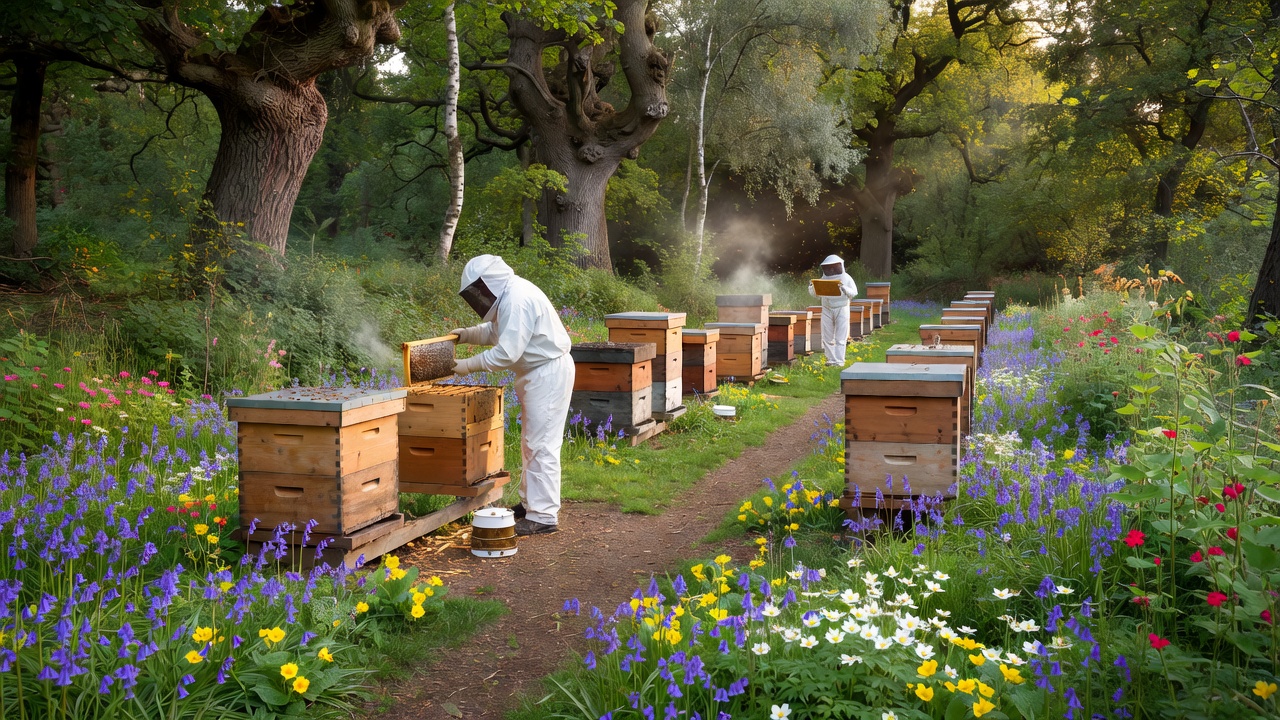
Honey begins with a changing supply of nectar or honeydew, not with an estate name. A property may contain carefully managed hives, yet the colonies can forage across surrounding gardens, woodland, agricultural land and uncultivated edges. That makes an estate a useful point of reference rather than a sealed production zone. For a provenance-minded buyer, the important question is how the beekeeper connects a particular batch to a documented place and period.
A specialist apiary may concentrate on a particular landscape, colony-management approach or seasonal crop. None of those choices automatically establishes superior flavour. They do, however, provide meaningful questions for a visit: where were the colonies, what was flowering, and when were the honey supers removed?
Read a mosaic, not a single flower
A photograph of lavender beside a hive is appealing but incomplete evidence. Bees respond to available forage, weather and competing sources. Even a landscape dominated by one flowering plant can contribute a mixture to the harvest. A floral designation therefore needs an appropriate combination of sensory, botanical and analytical support, interpreted under the rules that apply to the product.
Northumberland and the Scottish Highlands are useful places to consider heather landscapes; Provence offers a familiar setting for lavender discussions. These are regional examples, not recommendations of individual estates. A region contains variation in elevation, vegetation and management, so its name should open a conversation rather than finish one.
Keep the season attached to the place
Flowering dates move with local conditions. Rain can interrupt foraging, while dry conditions can reduce nectar availability even when flowers remain visible. Wind and temperature also affect access. A producer who discusses a difficult season is often offering more usable context than one who repeats the same flavour description every year.
Ask whether colonies stayed in one location or moved between seasonal flows. Migratory beekeeping is not inherently inconsistent with clear provenance. The issue is whether movements and harvest separations are recorded well enough to support the label. Combining crops from different sites may be legitimate, but it changes the story that can reasonably be told.
A small floral-source glossary
- Ling heather — Calluna vulgaris
- Associated with distinctive, often gel-like honey. Texture and flavour still depend on the actual harvest and handling.
- Sweet chestnut — Castanea sativa
- A source often discussed in relation to woody, bitter or robust impressions; these are tasting expectations to explore, not guaranteed findings.
- Black locust — Robinia pseudoacacia
- Frequently marketed as acacia honey in Europe. The common trading name should not be confused with a precise botanical genus.
- Mānuka — Leptospermum scoparium
- A New Zealand floral source with specific export-definition requirements. A plant association alone does not establish compliance with those requirements.
Look at husbandry without romantic shortcuts
Healthy colony management involves observation, disease awareness and decisions about food reserves. Visitors should not assume that leaving every intervention out makes an operation better. Equally, neat equipment is not a complete welfare assessment. Ask a host to explain the reasoning behind management choices rather than seeking a single visual sign of good practice.
Honey bee production is also distinct from conserving all pollinators. An apiary may coexist with valuable habitat work, but hive numbers alone do not demonstrate an environmental benefit. Meaningful claims need a defined scope and relevant evidence, including attention to wild pollinators and the local availability of forage.
Make an estate visit educational
Before travelling, confirm whether the visit includes live colonies, an observation area or only a processing-room presentation. Ask about protective clothing, uneven surfaces, accessible routes and alternatives for anyone unable to approach hives. People with concerns about sting reactions should seek appropriate medical advice before arranging close contact; an editorial guide cannot assess personal risk.
During the visit, take notes on the harvest date and batch being discussed. Ask permission before photographing staff, working areas or records. A useful conversation might connect one labelled jar to an apiary location, a flowering period and the next stage in the honey room. That chain is more informative than a general claim that everything is “estate made”.
Carry the landscape into the next question
Once you understand the forage story, follow the harvest indoors. Separation, extraction, storage and packing determine how the landscape account remains attached to the product. Keep a distinction between an explanation that sounds plausible and evidence linked to the jar in front of you. A memorable visit can deepen understanding without becoming independent verification.
Continue to extraction and handling
Reading and source notes
- British Beekeepers Association — introductory beekeeping and educational resources.
- Royal Botanic Gardens, Kew: Plants of the World Online — botanical names and plant distributions.
- Royal Horticultural Society: Plants for Pollinators — plant selection context, not a honey-origin certificate.
- New Zealand Ministry for Primary Industries — honey and mānuka export information.